

Buying a property consists of several main stages:
- What is the purpose of your purchase: to live in it or for investment.
- What kind of lifestyle do you want to lead in the new property?
- What kind of income do you want to receive from the investment?
- Decide in which country and settlement you want to purchase a property?
- Determine an approximate budget?
- Find a “personal broker” Together with the “personal broker”:
- Determine the appropriate neighborhoods
- Specify the size of your budget and the method of financing
- Choose the right property for you together with your “personal broker”
- Go through all the steps of the purchase and sale transaction
The sale of a property also consists of main stages:
- Choose a “personal broker”
- Together with the “personal broker” determine the selling price
In this article, we aim to give you detailed information about all the steps and documents that follow the decision to buy or sell a property.
It all starts after the BUYER together with their “personal broker” have performed the following actions:

The property has been selected and in order to complete the transaction, both the SELLER and the BUYER need time to prepare all the necessary documents to confess the transaction at a notary.
Situation 1: THE PROPERTY, SELLER and BUYER are in Bulgaria. In this situation, you can proceed directly to signing a Preliminary Purchase and Sale Agreement.
Situation 2: THE PROPERTY and SELLER are in Bulgaria, and the BUYER is in another country
Situation 3: THE PROPERTY is in Bulgaria, and the SELLER is in another country, and the BUYER is in a third country
In Situation 2 and Situation 3, the Buyer and/or Seller need additional travel time to gather in one place and sign a Preliminary Purchase and Sale Agreement for the selected property. This time can be provided by signing a Stop-Caparo document.
What are the main clauses in Stop-Caparo:
1. goal: to remove the property from the for sale advertisements and to give the BUYER time to arrive in Bulgaria or authorize another person to proceed to signing a Preliminary Purchase and Sale Agreement.
2. mandatory clauses:
- description of the property, according to the sale advertisement
- full price of the property and amount of Stop-Deposit (2000 - 5000 euros)
- if the BUYER cancels, loses the amount of the deposit
- if the BROKER or SELLER cancels, returns the deposit to the BUYER
- term of the Stop-Deposit: agreed between the BROKER, SELLER and BUYER
Note: if the payment is in cash, a Receipt for the amount paid and received must be signed, on the white back of the sheet the numbers of all banknotes are written and the BUYER AND BROKER sign the receipt.
Step 1: Signing the Preliminary Purchase and Sale Agreement
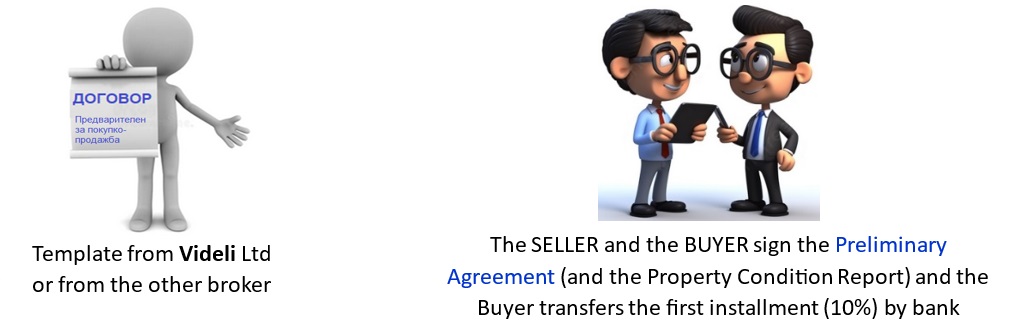
The SELLER and BUYER sign the Preliminary Purchase and Sale Agreement and proceed to prepare all necessary documents to complete the transaction.
Most often, the sufficient time to prepare all documents is about 30 days.
What are the main clauses in a Preliminary Purchase and Sale Agreement:
1. purpose of the contract: to provide time for the Seller to collect all documents and for the Buyer to provide full financing (mortgage from the bank or other financing option)
2. mandatory clauses:
- a full description of the property, according to the Notarial Deed
- the full price of the property and the amount of the first payment (10%)
- if the BUYER refuses, he loses the amount of the first payment (10%)
- if the SELLER refuses, he returns the amount of the first payment (10%) to the BUYER
- term of the contract: agreed between the SELLER and the BUYER, often 30-40 days are sufficient
3. The BUYER pays the amount of the first payment (deposit) of 10%,
- if the payment is in cash: A document is prepared Receipt for the amount paid and received, on the white back of the sheet the numbers of all banknotes and the BUYER AND SELLER sign the receipt.
Note: according to Bulgarian law, amounts greater than 10,000 leva must be of clear origin and paid by bank transfer
4. The SELLER provides the BUYER with a Copy of the Notarial Deed (or other document of ownership) upon signing the Preliminary Purchase and Sale Agreement
Step 2: Preparation of documents related to the sale of the property and financing related to the purchase of the property
.jpg)
SELLER:
When reselling a property, the SELLER collects the following documents:
Time required: 1-2 weeks
1. Identity document;
2. Notarial deed or other ownership document;
3. Sketch of the property - both the building and the land (in the Cadastre);
4. Tax Assessment Certificate with a copy of the sketch (in the Tax Office);
5. Encumbrance Document with a copy of the sketch (in the Registry Agency);
6. Marital Status Certificate (in ESGRAON);
7. Heirs Certificate (in the Municipality);
8. Civil Marriage Certificate;
9. Property Relations Regime Certificate (in the Registry Agency);
10. Certificate of absence of obligations under Art. 87 (National Tax and Customs Act Local Taxes and Fees);
11. Notarized declaration of consent of the spouse to sell the property;
12. Bank account document (from the SELLER's bank);
13. Other documents at the discretion of the Notary;
14. All utility bills paid: electricity, water, heating;
When selling a new construction property, the SELLER collects the following documents:
Time required: 1-2 weeks
1. Notarial deed for the land plot on which construction is being carried out or a notarial deed for establishing the right to build;
2. Sketch of the property (Agency for Geodesy and Cartography, Cadastre);
3. Design visa (from the Chief Architect of the Municipality);
4. Copy of the current PUP (detailed development plan) including the land plot and neighboring ones with marked existing buildings and structures, with building lines, permissible heights, building density and other requirements, if any;
5. Opinions of the operating companies for coordination of the Design Visa and preliminary contracts with them;
6. Approved Investment Project;
7. Building permit (stored in the Regional Directorate "National Construction Control");
8. Act 14 - stage of completion "rough construction", the individual buildings are already in place. It is drawn up and signed by the investor, construction supervisor and designer;
9. Act 15 - stage of completion, the building is now ready for commissioning. It certifies the suitability of the building, i.e. it was built in accordance with the investment project. It is drawn up and signed by the investor, builder, construction supervisor and designer;
10. Act 16 - permit for use / certificate of commissioning. From the Chief Architect of the Municipality or from the Regional Directorate of Construction and Building Control;
11. Table for area formation / area distribution of the objects in the building / complex with the signature and seal of the investor;
12. Current status of the investor from the Commercial Register;
13. Notarized protocol – decision on the sale of the real estate by the general meeting of the investor’s company – if it is an OOD or EOOD, or by the relevant management body of an AD;
14. Scheme of an independent site in a building – issued by the Agency for Geodesy, Cartography and Cadastre;
15. Certificate under Art. 87, para. 6 of the Code of Civil Procedure from the National Revenue Agency for the absence of public liabilities of the investor’s company. During the transaction, a declaration under Art. 264, para. 1 of the Code of Civil Procedure for the absence of public liabilities is also signed;
16. Certificate of tax assessment of the property – issued by the relevant municipality (district of Sofia Municipality) at the location of the property;
17. Certificate of tax assessment of the land on which the building with the property is located - in case that along with the purchase - sale of the property, ideal parts of the land will be transferred;
18. Certificate of entries, notes and deletions (certificate of real encumbrances) - issued by the Registry Agency or the relevant Registry Office. All contracts and acts are signed by the person/persons who are the manager or representative of the investor's company;
BUYER: prepares the following:
Time required: 2-4 weeks In case of financing without a bank:
1. Marital status (in the Municipality)
2. Document for the first amount transferred under the Preliminary Agreement (from the bank) In case of a mortgage from a bank:
1. All documents from the SELLER;
2. Document for income (from the employer);
3. Marital status (in the Municipality);
4. Certificate of Civil Marriage (in the Municipality);
5. Certificate of property relations regime (in the Registry Agency);
6. Document for the first amount transferred under the Preliminary Sale and Purchase Agreement (from the bank).
Step 3: Preparation of the transaction confession
.jpg)
In case of a mortgage from a bank:
1. The bank prepares all documents and submits them to a Notary for review and approval before the day of the transaction. The Notary is proposed by the bank or by the BUYER;
2. The bank organizes the date and time of the transaction at the notary.
In case of financing without a bank:
1. The BUYER's broker collects all documents and submits them to a Notary chosen by the BUYER for review and approval before the day of the transaction;
2. The broker organizes the date and time of the transaction at the notary.
Step 4: Confession of the transaction at the notary
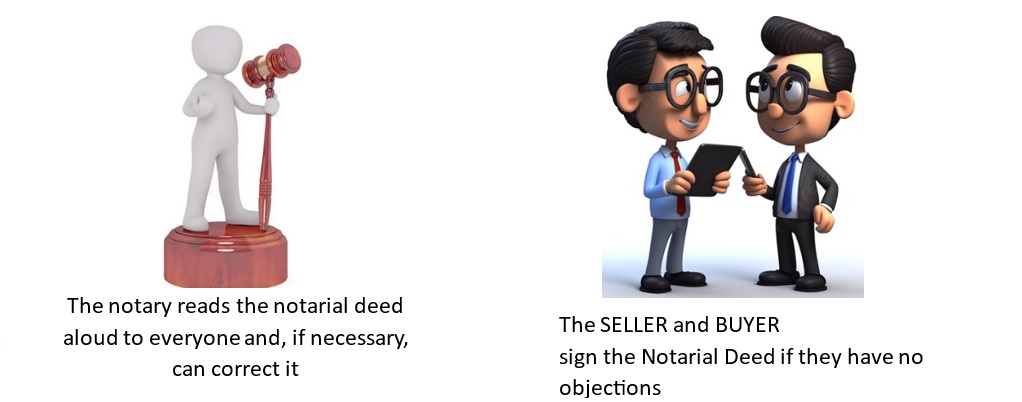
Attendees:
1. Seller;
2. Buyer;
3. Bank representative to prepare a notarial deed in favor of the bank, when the purchase is financed with a bank loan;
2. Brokers on the Seller and Buyer's side
Procedure:
1. The Notary reads aloud to everyone the Notarial Deed and, if necessary, can correct it
2. The Buyer reads the Notarial Deed and, if there are any remarks, informs the Notary
3. The Seller and the Buyer sign the Notarial Deed
4. The Buyer pays in cash/bank all local taxes and acquisition fees according to the law, including notary fees;
5. The Notary reads aloud the Notarial Deed with the bank providing the loan and, if necessary, can correct it;
6. The Bank representative and the Buyer sign the Notarial Deed with the bank;
7. The Notary notifies the Buyer when he can receive the Notarial Deed and agrees whether the Buyer will receive it in person or by courier;
8. The Buyer transfers the remaining amount of the property price by bank transfer.
Step 5: The Seller transfers the property to the Buyer
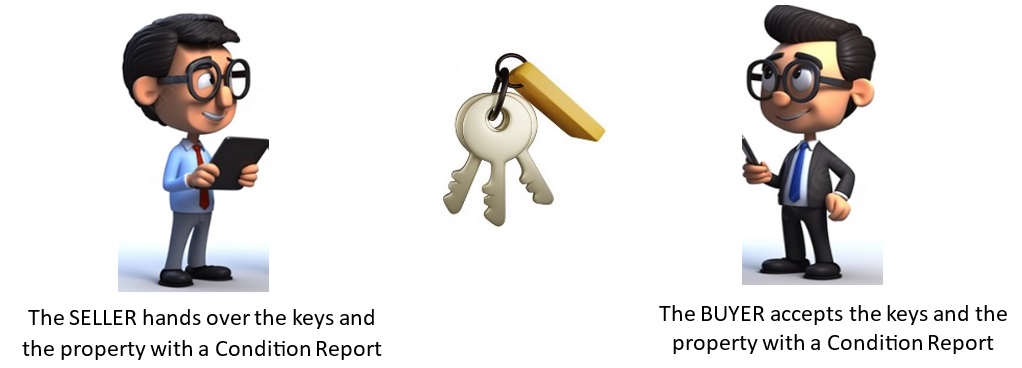
SELLER hands over the keys and the property with a Property Condition Report
BUYER accepts the keys and the property with a Property Condition Report
Step 6: The Notary registers the property transaction
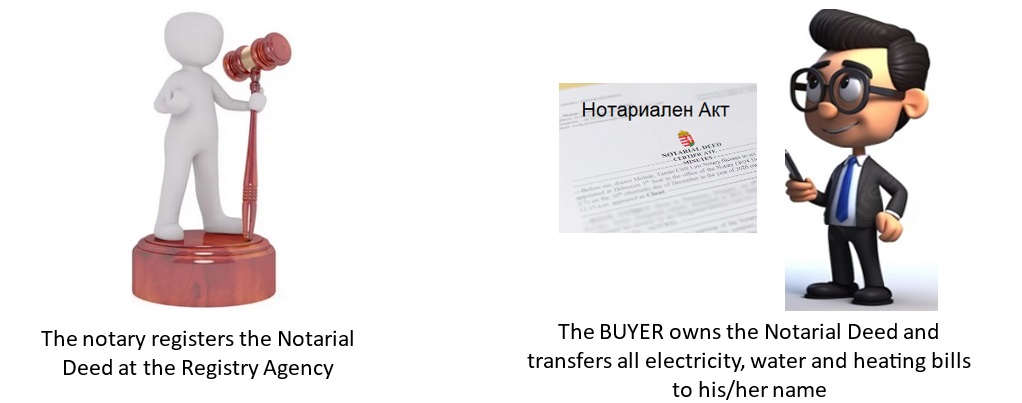
The Notary registers the Notarial Deed at the Registry Agency The Notary hands over the Notarial Deed to the Buyer.
This is the basic information, but each specific case may have additional specifics.
We at VIDELI will assist you in all cases!